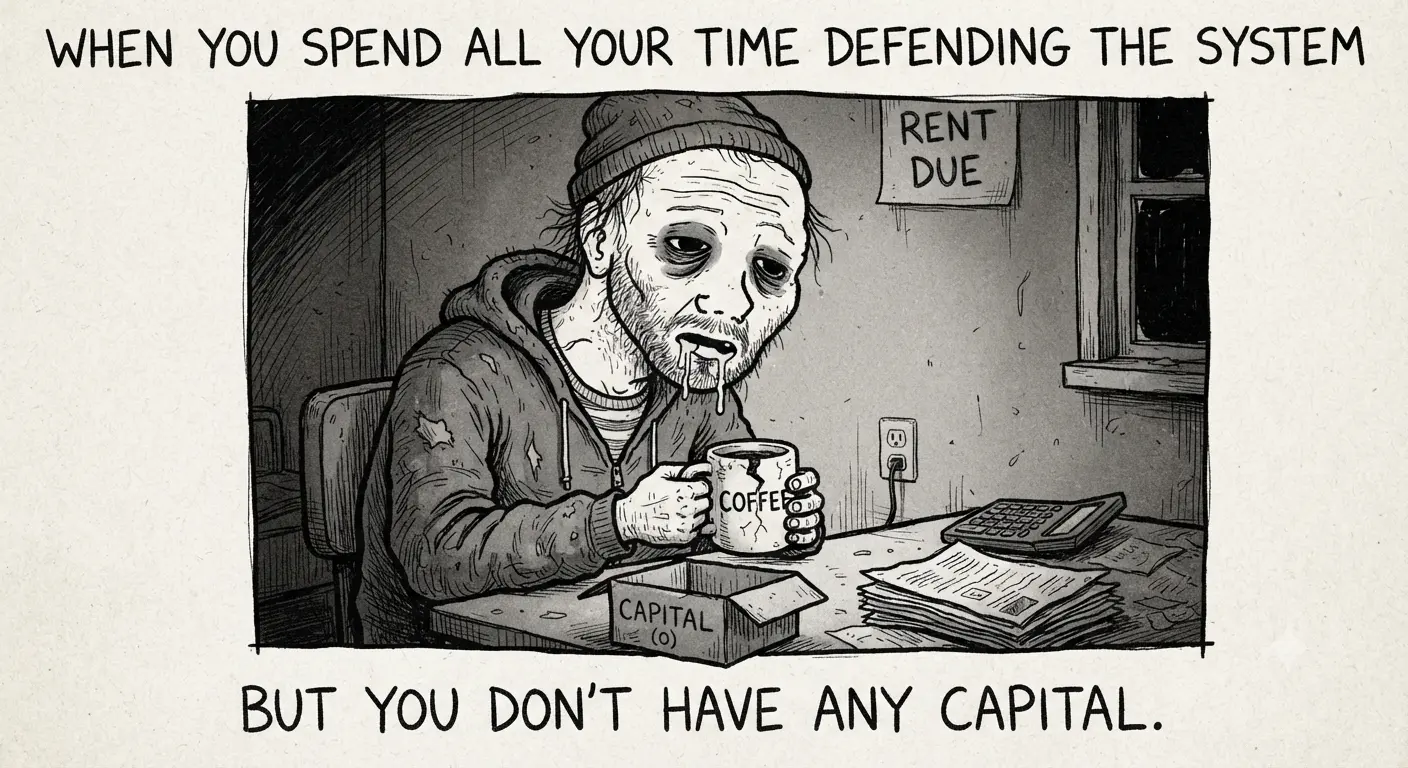
Here are 18 of the most common fallacies and pseudo-arguments deployed by “meritocrat capitalists without capital” — people who passionately defend capitalism on the assumption that they’ll one day be rich, and treat any discussion of communism as a debate-club smackdown. Each comes with a typical line you’ll hear and the reason it’s fallacious.
- Strawman Communism (Stalin = Communism)
“You want communism? So you want mass starvation, secret police, and gulags, then.” Equates the entire theoretical spectrum of communism/socialism with the most brutal 20th-century authoritarian regimes, ignoring democratic, libertarian, or decentralised socialist traditions.
- The Just-World Fallacy (Prosperity Gospel of the Market)
“If you’re poor, it’s because you didn’t work hard enough or add enough value.” Assumes the market perfectly rewards merit, ignoring inherited wealth, luck, systemic barriers, and the fact that essential work (caregiving, cleaning) is often paid appallingly.
- Appeal to Nature / Human Nature Card
“Communism goes against human nature — people are naturally greedy and competitive.” Cherry-picks one strand of behaviour, treats it as universal and immutable, and ignores massive anthropological evidence of cooperation, sharing, and non-capitalist societies throughout history.
- No True Scotsman (True Capitalism Has Never Been Tried)
“That wasn’t real capitalism, that was crony capitalism / state interference.” When faced with the failures of actually-existing capitalism (bailouts, monopolies, poverty), they shield the ideal by defining away every negative instance.
- Cherry-Picked Anecdote / “My Uncle Bob”
“My grandfather arrived with nothing and built a business — so anyone can make it.” Uses a single success story to “disprove” statistical evidence about declining social mobility, ignoring survivorship bias and the countless people who worked just as hard and failed.
- False Dilemma (Capitalism or Totalitarianism)
“You either have free markets or you have North Korea. There’s no third option.” Pretends the only alternatives to the present capitalist order are absolute dictatorship, erasing the existence of social democracies, co-operatives, and market socialism.
- Ad Hominem (Envy/Sour Grapes)
“You only hate capitalism because you’re jealous of successful people.” Dismisses structural critiques by reducing them to personal character flaws, avoiding engagement with arguments about exploitation, inequality, or climate crisis.
- Slippery Slope to the Gulag
“If we raise the minimum wage / tax the rich, we’ll end up like Venezuela.” Leaps from a modest social-democratic reform to complete economic collapse and dictatorship, without any causal mechanism linking step A to Z.
- Appeal to Consequences (Capitalism Works, Therefore It’s Just)
“Capitalism has lifted billions out of poverty, so it’s the only moral system.” Conflates descriptive outcomes (some living standards rose during industrialisation) with moral justification, ignoring the role of colonialism, fossil fuels, and worker struggles in those gains.
- Equivocation on “Freedom”
“Under capitalism you’re free to choose your job, start a business, buy what you want. Communism takes that away.” Uses “freedom” solely in the negative sense (absence of interference) while ignoring how economic coercion (work-or-starve) makes a mockery of freedom for those without capital.
- Begging the Question (Capitalism is Innovation)
“Capitalism drives innovation because competition breeds excellence — just look at the iPhone!” Assumes what it needs to prove: that market competition, rather than public research, open-source collaboration, or human curiosity, is the unique engine of innovation.
- Trickle-Down Pseudo-Wisdom
“When the rich get richer, they invest and create jobs. Taxing them hurts everyone.” Repeats a faith-based economic narrative that has repeatedly failed empirically, while ignoring how wealth accumulates at the top in unproductive assets.
- Relative Privation / Whataboutism
“You think capitalism is bad? At least we don’t have famines like in communist countries.” Distracts from the specific harms of capitalism (homelessness, medical bankruptcies) by pointing to worse horrors elsewhere, as if that justifies the status quo.
- The “Voluntary” Transaction Fallacy
“Workers freely signed a contract; they agreed to the wage. It’s a fair exchange.” Ignores vast power asymmetries, the background coercion of needing to survive, and the legal structure that favours capital, pretending a starving person’s “choice” is free.
- Genetic Fallacy (Marx Was a Lazy Rich Kid)
“Marx himself never had a real job and lived off Engels’ money — so his ideas are invalid.” Attacks the origin of an idea rather than the idea’s content or evidence; even if true, it says nothing about the labour theory of value or class analysis.
- Moral Inversion / “Greed is Good” Deflection
“Pursuing self-interest actually benefits society — it’s the invisible hand.” Transforms a vice (greed) into a systemic virtue through a mystical mechanism, ignoring externalities, tragedy of the commons, and the fact that Smith’s own argument was far more nuanced.
- Appeal to Spectacular Wealth (Dream-Fuel)
“Under communism, no one could ever become a billionaire or a rock star.” Frames the entire desirability of a system around the remote dream of extreme personal riches, a fantasy that serves to justify the immiseration of the very person making the argument.
- The “Woke Capitalism” Co-optation Gambit
“Look at companies supporting Pride — capitalism is already fixing social problems, we just need conscious consumerism.” Mistakes corporate marketing for systemic change, using surface-level inclusivity to neutralise anti-capitalist critique while profit structures remain completely intact.
In the hands of the “meritocrat without capital,” these fallacies aren’t just debating tactics — they’re a psychological lifeboat. Because if hard work doesn’t guarantee reward under capitalism, they’d have to admit they’re not temporarily embarrassed millionaires, just ordinary working people defending a system that will never love them back.
Comments
Post a Comment